
Price a Pokémon or sports card from a photo.
Worth reads a card the way a dealer does: the name, the year and set, the number in the corner, the stamp that makes it a first print. Then it gives you a range and says how sure it is.
The App Store listing is not up yet.
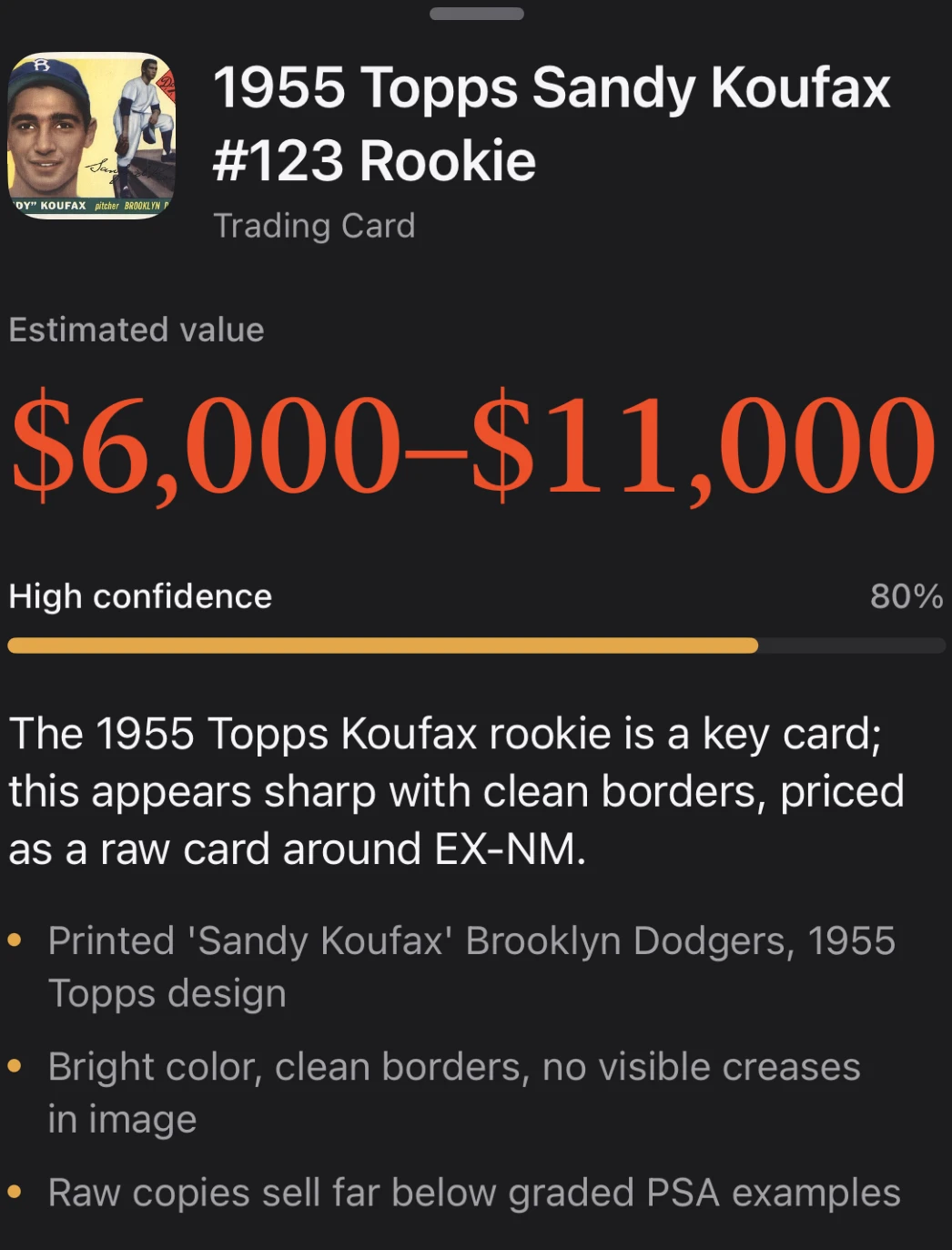
The answer above came from one photo of the front. A photo of the back, or the grade if it is slabbed, is the next thing Worth would ask for.
What Worth reads from the photo.
- The card
- The player or Pokémon, the year, the maker and the set, read from the printed front.
- The number
- The set number, such as 4/102 in the corner or #123 on a vintage card, which pins down the exact card.
- The printing
- First-edition stamps, shadowless frames, holo patterns and parallels, where the photo shows them.
- The condition in view
- Corners, edges, centering, creases and surface wear, as far as one photo allows.
- Raw or slabbed
- A graded slab is read for its grader and grade. A loose card is priced as a raw card.
What a collector checks next.
Each answer names the one thing that would move the estimate most. Tap a quick answer, type a line, or take the follow-up photo: the price is worked out again the moment it is taken.
Set and number
Two cards with the same picture can be different printings, and different money.
Show WorthIt is usually in frame already. If it was cropped out, Worth asks for it.
Edition stamp and print run
A first print and a later print of the same card are priced apart.
Show WorthA close photo of the stamp, or of the frame around the artwork.
Grade and slab
A grade from PSA, BGS, CGC or SGC replaces an opinion about condition with a number.
Show WorthPhotograph the label on the slab, or type the grader and the grade.
Centering, corners, edges, surface
These are the four things a grader scores, so they decide what a raw card could become.
Show WorthA straight-on photo, out of the sleeve if glare hides the surface.
The back
Whitening along the back edges is where many raw cards lose their grade.
Show WorthAdd a photo of the back. Worth prices the card again as soon as it is taken.
Questions.
- Can it tell a first-edition card from a later printing?
- It looks for the stamp and the frame. When the photo does not settle it, Worth prices the common printing and asks for a closer shot before it trusts the higher price.
- Does it price graded cards?
- Yes. Photograph the slab so the label is readable. The grader and the grade become part of the price, and the card is priced at that grade rather than as a raw card.
- How close is the estimate?
- It is an estimate from a photo, shown as a range with a confidence figure. It is not an offer and it is not a grade. It gets sharper when you add the back of the card or a fact about it, and when owners correct it.
- Is Worth free?
- Free to start: three scans a day, each with live prices, no account. Worth Pro is an optional subscription for forty scans a day and export.
Further reading.
The journal1st Edition, Shadowless, Unlimited: telling Base Set apart
The three English printings of the Pokémon Base Set look alike at a glance and are priced far apart. Here is how to tell them apart in under a minute, without a loupe.
Raw or graded: what a grade changes about a card
A graded card and a raw card can be the same piece of cardboard at very different prices. What graders look at, what a slab proves, and when grading is worth the fee.